I built an Obsidian plugin that finds and helps you tidy up the notes you once thought were important but that have quietly gathered dust. It’s out now as an official community plugin.
Hard to spot in the graph view
As a vault grows, so do its notes and backlinks.
When links pile up and cross-connect, the graph view turns a note into a catch-all that seems connected to everything. There’s plenty of information, but that abundance is exactly what keeps you from reaching the note you actually want.
Six years ago, in the very first piece I wrote here, I described the small magic in our pockets. The magic that stretches memory almost forever, and blurs the line around who owns knowledge. Since then my notes kept growing. The magic kept its promise and pushed my memory further and further outward.
And now I stand on its other side. Too many to find.
The papers I’m curious about but never sit down to read
I keep running into papers and long essays I’m genuinely curious about. The curiosity is real; the focus to sit down and read them is not. Reading is active work, and I rarely find the slot for it.
The time I do have is the passive kind — a commute, a walk, the few minutes I spend staring out a window. That time arrives whether I plan for it or not, and for this kind of material those moments are actually the best ones: listening slots into them in a way reading never will. So what I want isn’t a summary to skim or a transcript. I want the thing broken down plainly enough that it comes in just by listening, hands free.
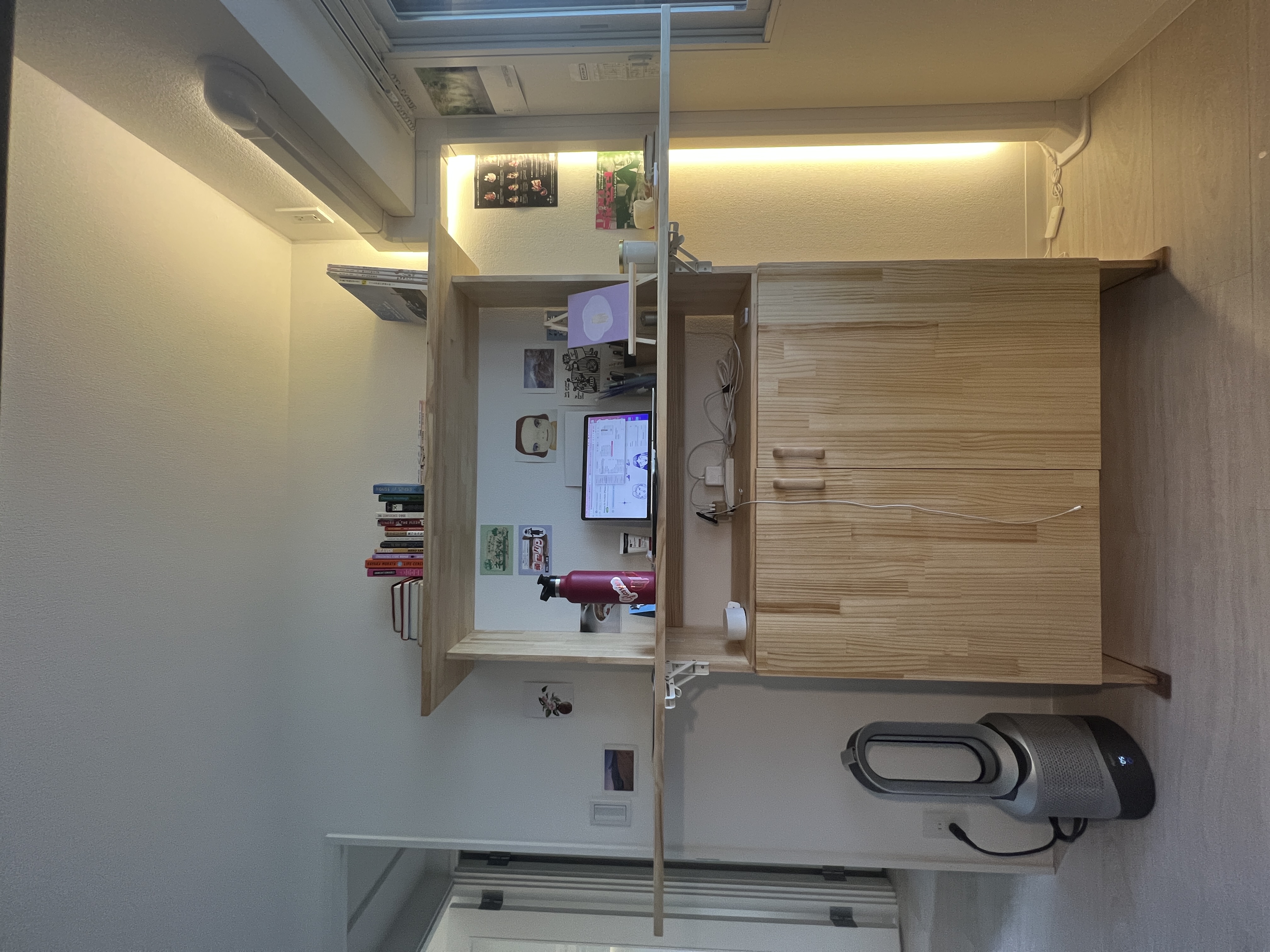
Anyone who likes making things eventually runs into the same problem: where do the things you make actually go? A 6 tatami room (about 9.7㎡) has to hold craft materials, display the things you make, give you a surface to work on, and still seat you on a sofa at the end of the day. Pile four jobs onto one room and every off-the-shelf option falls short.
An Obsidian plugin that automatically counts meaningful edits and helps you keep track of the notes you revisit most. It’s been working well enough on my end, so I’m releasing it as a beta.
Starting Point: Finding the “Heavy” Notes
After using Obsidian for over 3 years, my notes had grown considerably.
When I opened the graph view, every note appeared at roughly the same size. Link count does affect node size, but that reflects “how connected” a note is — not “how actively I’m thinking about it.”
It became a chance to revisit what a valuable note really means to me. The answer: notes I keep opening, adding to, and rewriting. In other words, notes with a high edit count.
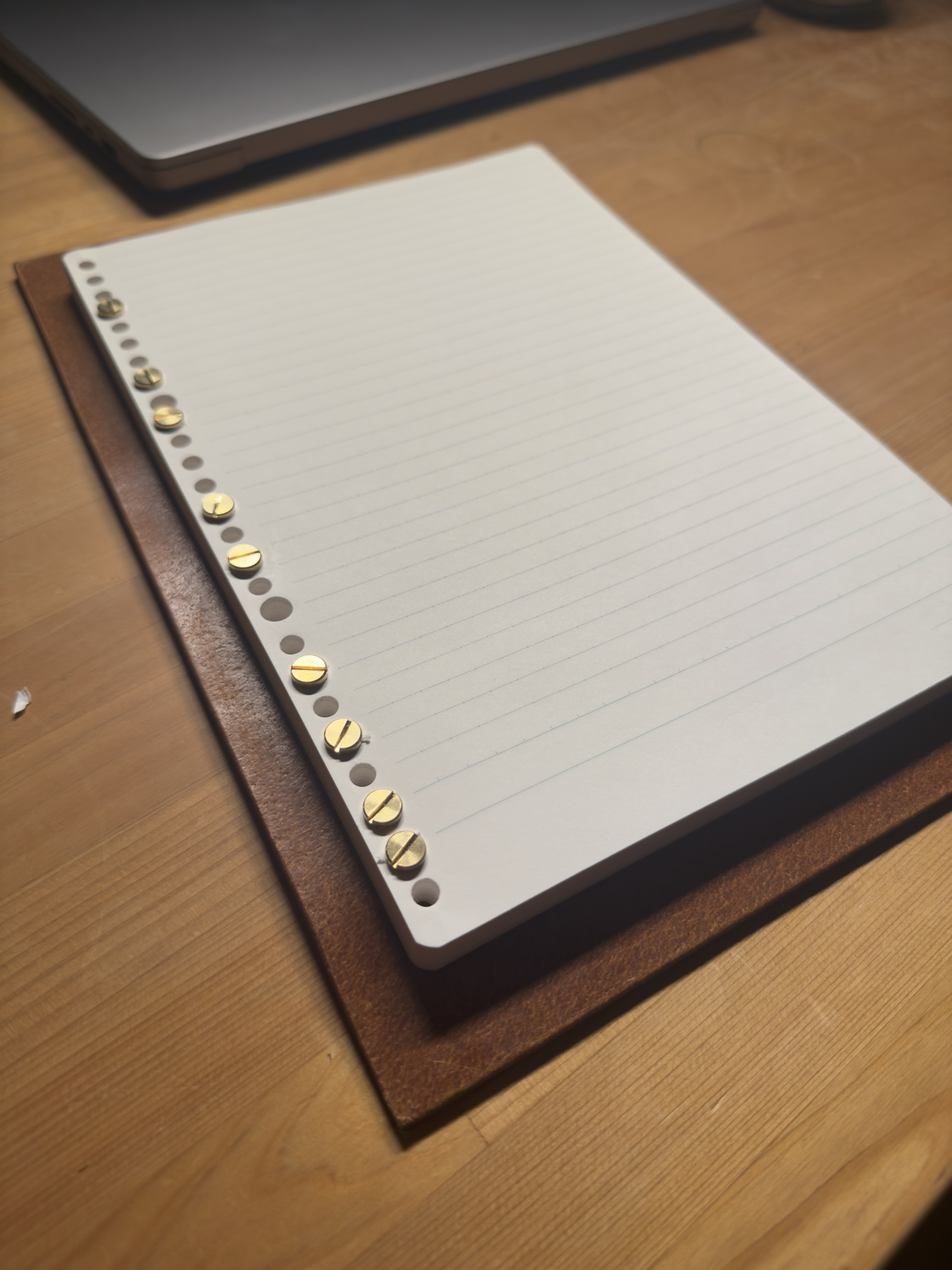
I made a binder to manage my loose-leaf paper using leathercraft.
I wanted a tool that I would want to keep on my desk, something that would lift my spirits just a little.
This is a Google Apps Script (GAS) tool that automatically calculates the travel route (train/walk) to an event when you add it to Google Calendar, and adds a “Travel to…“ event to your calendar.
It all began with a common problem: I wasn’t getting enough exercise.
Remote work became standard, which was flexible, but it also meant I had days where I didn’t leave the house at all. I knew I needed to change that, so I started a new habit: just walking.
“Humans are happy creatures because they can forget.”
This is a phrase my math teacher taught me when I was a student. At the time, I didn’t think much of it, but in today’s world, where information constantly floods us, I deeply feel the weight of these words. This isn’t just a philosophical question; it’s an extremely practical wisdom for maintaining mental and physical health and having the space to think in this information society.
Every day, we are exposed to an enormous amount of information: work tasks, news, social media and app notifications, personal notes. If we tried to remember everything, our brains would quickly become overwhelmed.
Generative AI has become capable of telling sophisticated lies indistinguishable from human ones.
Precisely because of such an era we must not delegate “understanding” itself to AI.
Gathering and interpreting information in our own way and putting it into your own words has become ever crucial. Because without it, connecting disparate knowledge and experiences to form a single thread, will be impossible.
This act of “connecting the dots” is the essence of thought: a domain that must never be delegated to others let alone AI.
Our 6-mat room is our dream workshop. To make miscellaneous goods, we want to use it not only for storing materials, but also as a display, a workspace, and a relaxing space. A large-scale challenge to create furniture that fulfills such requests.
Due to the worst-case scenario of the global warming prediction for 2050, in mid-2047, the United Nations headquarters issued a statement that swift and unprecedented global cooperation was necessary. As part of this effort, Japan adopted a new era name after in 2050, which was shared with the rest of the world.
Tried DIY! Gifting a Custom-Made Workbench to My Art-Loving Wife
Hello, everyone! Last month, I took up the challenge of making a unique workbench that can’t be found in stores, just for my art-enthusiast wife. I’ve written down the entire process for you here.
I saw a new step in the revolution so I’m writing it down. I got a new face.
You’re what you are seen is the same perspective in the computational world and in the non-computational world. However, the difference is that in the former world we can go beyond of our appearance that is tied to the non-computational world. In reality, ML and traditional computation are merged with the non-computational world, and the definition of “What am I in this world? keeps changing. Rethinking how to be in this world, it is surely more of the state of fusion than ever. The data used to create the new face is the mugshots of the non-computational world, but let us not forget that it was predominantly the gift of the visual arts of collective wisdom.
When embarking on a journey, what do people think about? Visiting unknown places, eating cuisines that they have never tasted, and getting in touch with histories and cultures of the place. They may discover something new, or be able to reflect on their footsteps in their life.
Tokyo is colorless: A frozen city, said one that named after this city as I have heard of. Black, grey and white cover the city: yes, I’ve come to find it cold and colorless. Looking around the city and upon my foot, I have probably become part of the crowd as well. Recently my days over the lenses have been covered by black, grey and white.
But once looking at this afar, I come to notice something. Once looking at the map from high up, how much the green and the blue surround this city. Once looking upon the afterglow over the cloud, how much of the sky is being filled with the comforting orange.
And the colorful and beautiful food culture lies place to place. The ingredients transform themselves into smaller pieces, traveling miles and miles from an island afar. Here is also a town of gastronomy.
Sustainability, being light and fuzzy like feathers, is a shapeless object. I’ve been trying to catch it with my own hands with certain special feelings. At times it forms a tangible shape, leaving me spark-joy; other times it goes through my fingers deceptively.
As far as I can remember it, I couldn’t help but come to view it again and again. Because that is what something beautiful makes you want to do. I just cannot leave it and look for something else for a long time.
Interestingly, I cannot define it as one particular thing. However, I can bring some successful examples which I was able to grab as something tangible. It’s when seeing an electric vehicle accelerating in the blink of an eye with its quiet three-phase alternative current, right next to a fierce petro one that cannot hold its fuel exploding inside. It’s when using a soft bamboo tooth-brush with its wood scent, instead of one with inorganic, artificial and colorful plastic. It’s when wrapping a gift with a furoshiki that is reusable, robust and uniquely patterned, instead of disposable wrapping paper that cannot erase its own past wrinkles.
What is intelligence? I believe it can be represented by a tree.
In the human tree, there are various elements: objectively guaranteed facts that exist outside human preferences, such as scientific truths; opinions that can be mutually exclusive and contradictory; and ingrained common sense from one’s cultural upbringing.
Physics and Bayes’ theorem in Mathematics both contain the notion of measurement.
In the middle of the revolution, here we stand. What’s the best way of making the most of the internet? This question drove me to launch this website.
Maybe there’d be some total nonsense, or some unhindered truth that remain untouched by mainstream. This sea wides open here and there, and is too vast and deep. It continues limitlessly and one may not be even able to see its horizon.
Hang on, take a moment and look away from the screen. Then I want to ask you; how the world at the front of you appears?